
To website or not to website, that is the question
For years, organic content, driven by SEO, was an absolute powerhouse driving reams of nice warm prospects to your website to engage with whatever spicy wares you were promoting.
Now, as we head into the closing months of 2026, spinning wildly towards the AI first web environment of 2027, we can see even first place organic listings failing to drive even 1% of users to your site. To put that into real numbers – for every hundred times you show up at the top of the page, you might get a single sad click (and often less). It is not just search either, and social now also drives practically no clicks to your website.
So, the obvious question is the one nobody really wants to ask out loud: if nobody’s clicking, why are we even bothering with websites?
It’s a good question.
Organic traffic is down. Blog content does nothing to bring folks in – why would it? AI answers the question before anyone needs to visit. Sure, you may get a citation or a link in the AI but nobody really clicks those.
Our old traffic-focused dashboards often look very sad with only a handful of clicks coming through that are not for people searching for you by name.
The website, once the centrepiece of our traffic-driving digital marketing strategy, is starting to feel like an expensive and potentially unnecessary habit.
I get it.
We have been thinking about this a lot.
The landscape has changed. Search & Social are walled gardens that send little traffic. AI is worse still.
The problem then looks a little like this.
- We assess the utility of websites through traffic and engagement
- Yet maybe 80% of that traffic has gone and it is not coming back
- The traffic we do have is very different
From what we are seeing out there this shift in traffic, without a change in thinking and measurement criteria, is leading people to make some bad website decisions that I feel could hurt their marketing in 2027 and beyond.
The rest of this article looks at a couple of the pitfalls, and then lays out a better path forwards so you can flourish in this new traffic-lite world!
To website, or not to website, that is the question
In a world where clicks are down and websites are primarily assessed based on the total amount of traffic that they have to work with, we can easily make a couple of bad decisions.
- Ignore it and let it rot
This is probably the most common and the logic goes something like this:
Traffic is down, the website matters less, let’s spend less time on it. The blog was last updated in 2023, case studies in 2021, the messaging is out of sync, your services describe what you were doing three years ago and not the reality of your day-to-day now.
But hey, nobody looks so what does it matter?
Right? Wrong!
- Crank it out with new fancy AI tools
The opposite reflex is to use these fancy new tools to combat the lack of traffic.
Get a new fancy design done by AI, some whizz-bang messaging about how service-focused you and your bespoke solutions are.
Then of course, use more AI and generate a hundred new blog posts and drop them all in one go. More content equals more clicks – right?
All very nice, low effort, easy to achieve, and utterly pointless.
Changing our thinking
Okay, so there are two options here.
Both leave you in exactly the same place – with a website that says absolutely nothing distinctive about who you are.
Marketing slop (as my 14 year old would say).
Differentiation is a marketing problem as old as time, that AI has set alight and poured jet fuel on. The good bit though is that this is also an absolutely huge opportunity for those with a little inspiration and a ton of perspiration to move with the times.
The first job is to accept the changes:
- Fewer humans are reading your website
- The machines are reading every single word
Really stop for a second and consider that second one, as even your best customers only ever read a pinch of what you put out – the machines read everything.
If your website is stale, generic or incorrect, then that is exactly how AI will describe you to people who are about to make a purchase decision.
Any gaps in what you do, why people should care, or anything else, and the AI will either make something up or rely on out-of-date information.
An out-of-date or shiny-but-generic website will not just fail to attract visitors, it will train the AI to see you as bland, dull and utterly forgettable.
The alternative – measure what matters
There is a concept known as Goodhart’s law. The general idea is that when a measurement becomes a target, it ceases to be a good measurement. Clicks and traffic have been like this for a good while now and long before AI started to eat all our clicks.
We have measured marketing performance and websites by traffic for twenty-five years. I have seen a lot of websites with a lot of traffic and much of it doing nothing more than driving up their website hosting costs.
So, whilst this is a convention and should not be carelessly denigrated and cast aside, raw traffic numbers have been a poor measurement for a good while and it is now time to let them go quietly into the night.
Really?
Yes, really. Stop and think about it.
Traffic was always a proxy for engagement and conversion.
It was a rough signal that something was working, that people were finding you, that the machine was turning.
Website traffic now has little to do with whether your website is doing its job and that engagement that used to happen on your website now mostly happens elsewhere.
This leaves us with two jobs that your website has to do in the AI Era.
Job one: the source of truth for the machines. When an AI tool goes off to research your market, it reads your website along with everything else. Your site is the one place where you get to state, in your own words, exactly who you are, who you help, and why you are different. Any knowledge that the machines gather about your business starts at this central point.
Job two: closing the deal. The people who do turn up are not the cold, curious browsers of old. They have already asked the AI. They have already seen your name, maybe several times. They arrive primed, warmer, and much further along the journey. These are users in the final stages of comparison and should be yours to lose!
Fewer visitors. Better visitors. And a completely different job to do when they arrive.
The rings of strategy & communication
There is a simple way to think about how all of this works that is based on a series of rings.
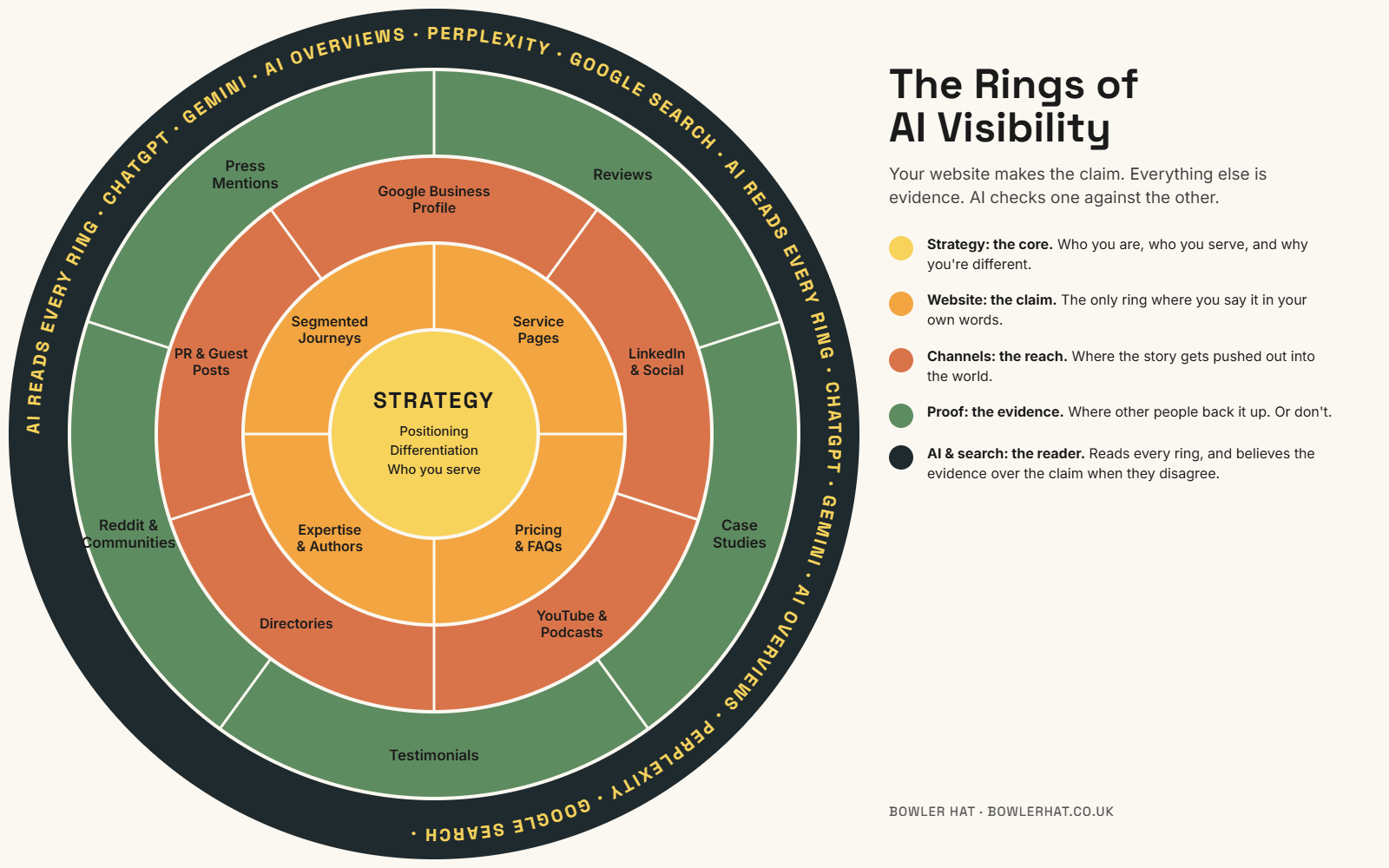
At the centre: strategy. Your positioning, your differentiation, your product, your messaging. The stuff that makes you, you.
Wrapped around that: the website. This is where you talk about your strategy yourself. It is the claim that you make.
Further out: the channels. PR, social, guest posts, podcasts, directories – where that story is pushed out into the world.
The outer ring: proof. Reviews, case studies, testimonials, reputation. The places where other people evidence what you claim.
I like to think of this like triangulation – truth is established by looking at three points or angles.
Your website is where you first push your strategy out into the world. The claims you make, though, are only as good as the evidence that AI can check it against. When the claim is clear and the evidence backs it up, the picture snaps into focus and you become the obvious answer to a specific question.
When there is no claim – because the website is stale, or because it is fifty posts of generic AI marketing wallpaper – the AI has nothing to check the evidence against. It fills the gap with the generic. And generic does not get recommended. Generic gets you ignored or, worse still, competing on price alone.
Once your strategy is realised, the website is the only ring you fully control. Abandon it, and you hand the story to everyone else.
Closing the Deal
So, what does the website actually need to do for this new kind of visitor?
First, remember who’s arriving. They’re not cold browsers anymore. They’ve asked the AI, and maybe even engaged with you on social media. They’ve seen your name, maybe more than once. They land on your homepage half-decided, and they’re looking for a reason to say yes or a reason to bail.
That leaves the website with four jobs to close the deal.
- Recognise them. Visitors need to see themselves within seconds. Different people arrive with different needs, so the site has to sort them fast and point each one to the right path. If you confuse them, you lose them.
- Confirm the story. The visitor already has an idea of you, from the AI, a review, or a friend. The website has to match it. If the AI said “specialist in X” and your homepage says “full-service solutions for businesses of all sizes”, you’ve just planted doubt at the worst possible moment – your messaging must line up.
- Remove the risk. A primed visitor isn’t asking “what do you do?” any more. They’re asking “is this safe?” So give them prices or price ranges, clear FAQs, how the process works, and proof that people like them have done this before and been glad they did.
- Make the next step obvious. One clear action for each type of visitor. Don’t make someone who’s ready to buy hunt for the door.
Fewer visitors means each one is worth more. You can’t afford to fumble the ones who turn up.
What to do this week
Three quick checks:
- Read your homepage as a primed visitor. Someone has heard your name from an AI tool. They land on your homepage. Can they find their path in five seconds?
- Ask the AI what it thinks of you. Then read your own website. Is the AI repeating your claim, or making one up for you?
- Check your segments. List the different types of people who arrive. Does your navigation speak to each of them, or to nobody in particular?
If any of those are uncomfortable, that is your starting point. Planning frameworks like ALCHEMY exist for exactly this – working out who the website is for now, and what it needs to do for each of them.
Nobody visits your website? Fine. The ones who do are the ones who matter. And the machines are reading every word.
Make sure it’s worth reading.
