
Google has this week published a guide to help seperate clear some of the smoke and mirrors around optimising for AI features on Google Search.
The guide answers some of the big questions around AI and Google Search:
- Is SEO still valid?
- How should you optimise for AI features?
- What don’t you need to do, buy or worry about!
The guide, like all the best Google documentation, is a little technical, so the purpose of this post is to just provide a basic overview with the primary points explained in a way that I hope makes them actionable to all businesses and marketers, despite their knowledge around Google, SEO and AI.
AI and Google – The Modern Search Landscape
Google Search has been in a state of evolution since day 1.
You may notice new things that crop up, and you may not, or you certainly soon forget as these features of the results soon become commonplace.
The latest (and greatest) of these search features are the AI Overview and AI Mode.
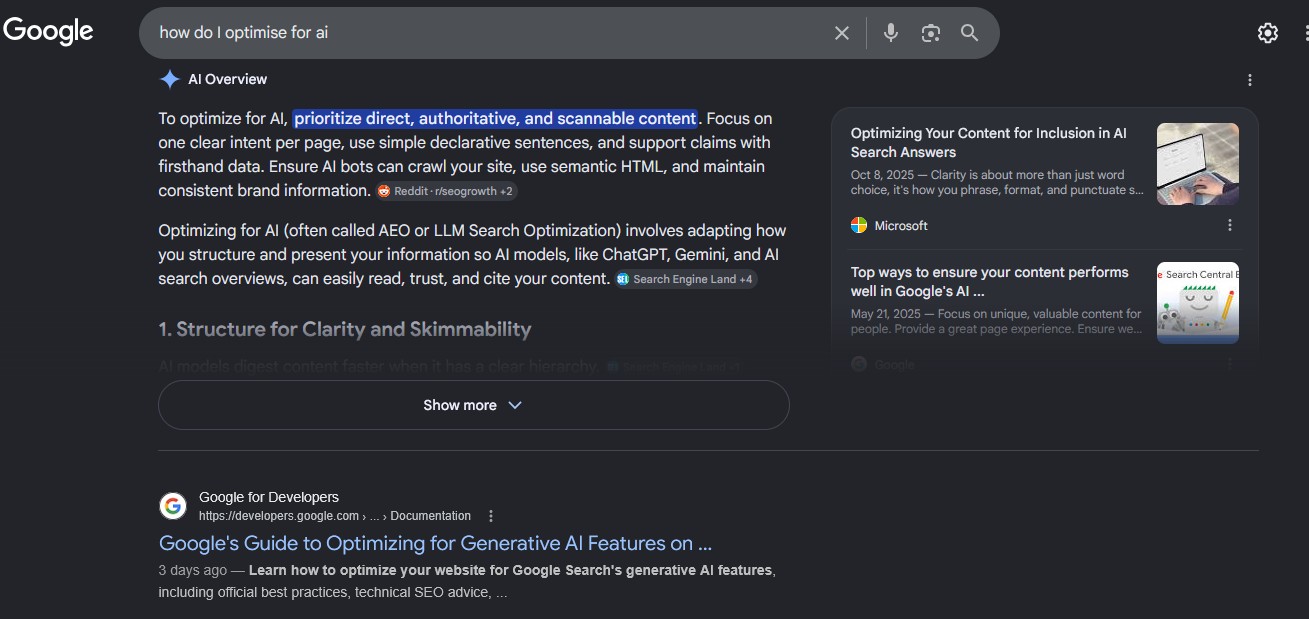
The answer will typically have a “Show more” button that reveals the full answer and then has a box so you can “Ask anything”.

Clicking “Ask anything” will dive you into Google’s AI Mode where you can have a full conversation with the AI and get the answers to all of your deepest and darkest questions (or just boring marketing stuff!).
SEO or GEO?
A facet of modern communication is that we tend to argue about things – a lot and SEO vs GEO has been no different.
One side argues that GEO is a completely new thing and the other argues that GEO is really no different to SEO at all.
The dull, but obvious answer here is that obviously, the truth is somewhere in the middle (and probably a lot more on the SEO side).
Well, Google have now chipped in and answered this question for us:
Is SEO still relevant for generative AI search? In short, yes! The best practices for SEO continue to be relevant because our generative AI features on Google Search are rooted in our core Search ranking and quality systems. These features rely on AI techniques to highlight content from our Search index.
In a nutshell the AI tools (and AI embedded in services like Google Search) all use a few simple techniques that themselves rely on search:
- Query fan-out: when you ask a question Google will take that question, break it up into relevant queries and then expand upon those queries to conduct multiple relevant searches.
- Retrieval Augamented Generation (RAG): this is where the AI searches using the Query fan out queries and then uses this information, in addition to what it already knows, to form a generated answer. To make sense of this strange term, it is augamenting its own knowledge with the information retrieved.
So, AI is different, in that it is a different tool that we use in different ways, but at the base of that tool Google search, and that creaky, old fashioned SEO is still super relevant.
Optimising for Google AI
So, how exactly do you optimise for AI?
The tactics are essentially no different to normal SEO.
You need a site that ranks and you need content that answers your customers questions and helps them achieve their goals.
You don’t need to worry about a lot of what has been banded around (chunking, LLMS.txt etc) and you can focus on just creating truly useful content across the spectrum of your products and services.
1. Write content that’s genuinely useful – not just filler
Generic content is of no use. You need content that stands out, is unique and adds additional value above and beyond what is there currently.
E-E-A-T: Experience, Expertise, Authoritativeness, and Trustworthiness – whilst not a ranking tool or signal, it is a useful framework for evaluating what you are writing and ensuring you bring something to the table that the AI can’t – which is real world experience and expertise.
The practical takeaway here is that you share your real experience and opinions. Write for your actual customers, not for search engines. Don’t just repeat what everyone else in your industry says.
2. Make sure Google can actually find your website
Google’s AI can only recommend you if it can read your site in the first place.
As the AI will search, you need to conduct a quick review to ensure you are visible.
The best way to do this is to look at Google Search Console and see what kind of queries you show up for and if you are getting traffic.
Also conduct typical local queries to see if you show up.
If you don’t show up in the results, you won’t show up in AI.
3. Things that don’t matter
The internet is full of “AI SEO hacks.” Here’s what Google itself says you can safely ignore:
- Creating special AI files (like “llms.txt”) – Not needed. Google doesn’t give these any special treatment.
- Breaking your content into tiny chunks for AI to read – Not needed. Google can read a normal webpage just fine.
- Rewriting all your content in a specific “AI-friendly” style – Not needed. Google’s AI understands normal human writing.
- Paying for fake mentions of your business across random websites – Doesn’t work, and could actually hurt you. Google ignores or penalises this.
- Adding lots of technical code tags to your pages (structured data) – Useful in some specific situations, but not a magic AI-search fix.
The simple version
If you want to be found in Google’s AI search results, focus on three things:
- Ensure your basic SEO is solid and you have visibility
- Have a well structured website that says something genuinely useful
- Ensure you have credible visibility around the web to build trust and confidence (for people and tech)
That’s it. You don’t need a new strategy – you need to do the fundamentals well and build on the foundations of what has worked in SEO for years.
The Google Guide
For those of you looking for more detail and information straight from the horses mouth (and who can handle the fact it can be a bit of a snoozefest) – read on:
https://developers.google.com/search/docs/fundamentals/ai-optimization-guide
