
Have you got less traffic than you had last year?
Is this despite carrying on with SEO, online advertising and other digital marketing tactics?
Things have been going in this direction for a while now, but as we head into 2027 we have hit a tipping point and the old way simply does not work any longer.
If you are throwing good money/time/effort after trying to combat falling organic traffic or hiked PPC costs, then we can help you understand so you can adjust course and reposition your tactical approach for success in 2027.
Digital Marketing – 2000 to 2025
For the last 25 years, digital marketing had a fairly simple premise:
- Get in front of people
- Get them to your website
- Engage them
- Convert them
- Credit the channel
It is time for some tough love here – that model is done. Totally cooked. Don’t double down here, it is time to change the approach.
Did a crocodile eat my traffic?
In ye olden days of 2000 to 2025, an increase in impressions in Google Search Console (how often you show up, basically) was generally a good thing and clicks would typically follow.
In 2026, we have seen a very different pattern:
- Impressions have gone up
- Clicks have gone down
This has been dubbed the crocodile effect with the traffic graph now having more in common with a crocodile’s open mouth than with the typical “impressions > clicks > conversions” model of yesteryear.
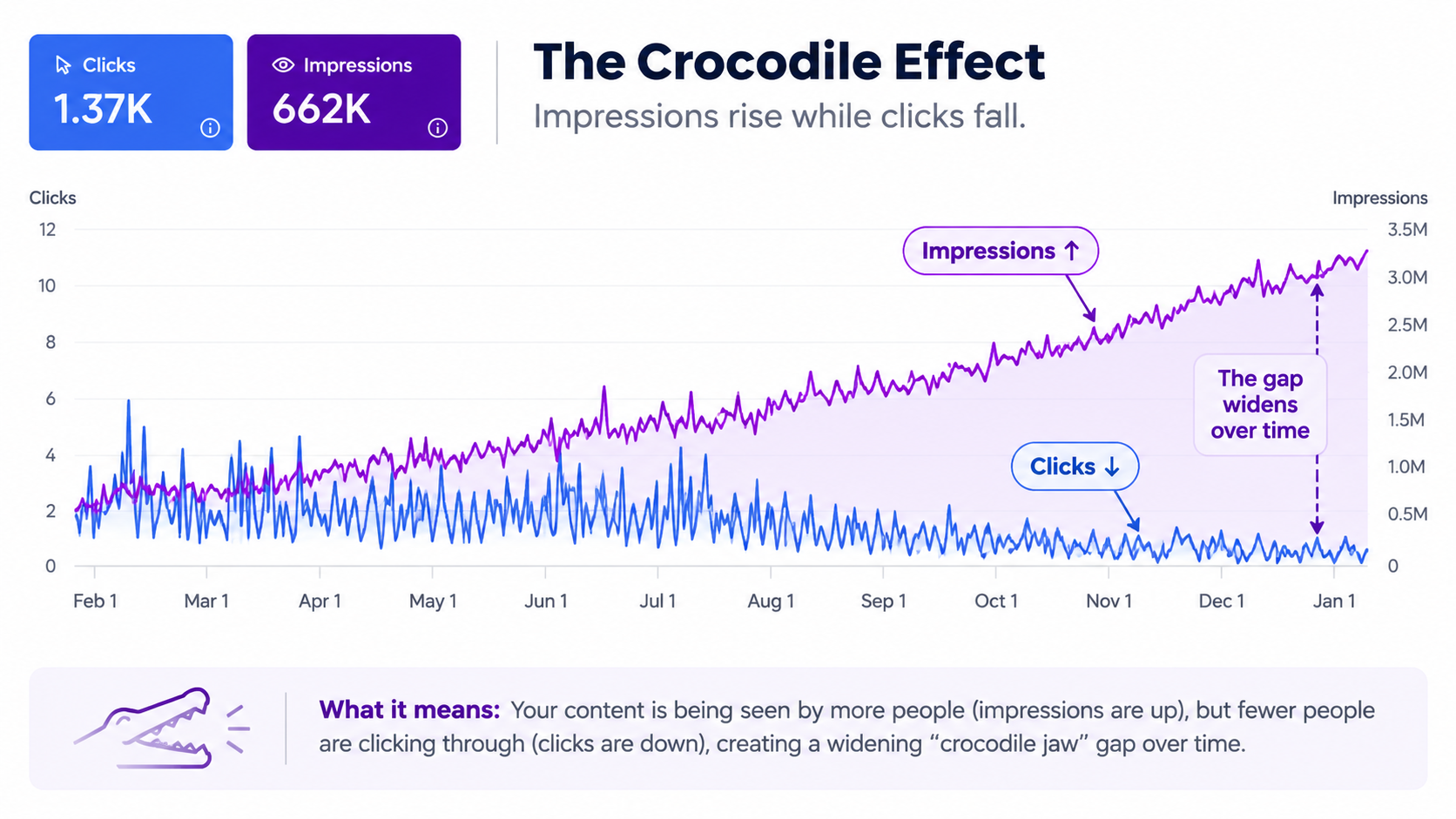
Insane in the membrane
There is a human tendency, when something stops working, to just double down and try harder. Something stops producing results so we increase the effort rather than question the approach.
Change is tough, we like to do what we know and we may have invested so much already it is hard to walk away.
The Click Apocalypse
The issues we are seeing here have been gathering at an insidious pace for years now, but in 2027 the writing is on the wall and both have reached a critical tipping point.
The key to moving forwards is to understand where those clicks have gone, to change tact and to remodel your marketing approach into something that will work in 2027 and beyond.
1. Zero Click
I am not sure how popular this term is but it is likely the best way to describe the stark aversion to outbound clicks of all the big digital marketing agencies.
Every major platform is now a walled garden. They do everything they can to avoid sending users anywhere else, including your website.
Google, LinkedIn, TikTok, Instagram, YouTube and the rest make money by keeping your attention and showing you ads.
The numbers tell the story. In 2019, around 49% of Google searches ended without a click. By 2024 it was nearer 60%. In the first four months of 2026, it was 68% in the US, and the UK was even higher at 69.5%.
Social platforms range from not allowing links at all to quietly penalising posts that include them. Add a link and your content sinks like a stone.
Be under no illusion: this is by design. Google was once built to get you somewhere else with as little friction as possible. Now it’s built to keep you on Google, clicking ads.
This isn’t a glitch. This is not going anywhere. It’s the business model. The platforms want you to stay.
If you’re still fighting that, you’re probably having a really bad time.
2. AI
I am pretty sure you will have heard of AI, you probably even like it as a business owner or marketer.
AI is not just a new channel, it is way more than that. AI is a completely new way of finding answers and it is being weaved into every aspect of our digital lives.
People now ask ChatGPT, Gemini or Claude to do the research, compare the options and build the shortlist. What once took ten searches, a dozen tabs and a ton of human-donkey work now takes one conversation.
For anyone tired of the old web, where doing anything meant battling ads, pop-ups, remarketing and sponsored posts, AI is a breath of fresh air. It makes life easier, so it’s here to stay whether you like it or not.
The key shift is that people are handing over the work. They aren’t just finding information faster. They’re letting a machine narrow down the choices for them. Every business now has to factor that into its marketing.
Where they overlap
You can see the overlap most clearly on Google. AI Overviews and AI Mode use AI to deliver zero click at scale.
When an AI Overview appears, the top-ranking result now gets around 58% fewer clicks. People click the links inside the AI summary itself only around 1% of the time. Inside AI Mode, more than nine in ten sessions end without a visit to any website.
The standalone AI tools also send very little traffic, despite the rush to sell GEO, AEO or whatever fancy AI acronym you prefer (we use our own system, ASC).
Don’t get it twisted. AI will not replace SEO. These platforms are burning cash in the AI wars so they’ll become walled gardens of their own fuelled by ads, credits and subscriptions. They certainly won’t be the replacement for SEO traffic that many hope for.
This is where things are falling apart
The old way of marketing was built on the assumption that clicks are the primary outcome of marketing tactics and that the website visit is where the magic happens.
Now the awareness, influence, research, comparison and often the decision all happen somewhere you can’t clearly see, across the walled gardens of search, social and the wider web.
Here’s what that looks like for a typical SME. Sarah needs a solar panel installer. She asks ChatGPT for recommendations in her area and your name comes up. A week later she sees one of your posts on Facebook. A month after that, her neighbour mentions you. She searches for your business name and calls you.
Your analytics shows one branded search visit, or even worse, nothing, as she just tapped your phone number in. The AI answer, the social post and the word of mouth that actually did the work don’t appear anywhere tied to any kind of attribution so you figure they don’t matter.
Fair attribution, tough enough to begin with, and already on the ropes due to privacy laws, now often does more to mislead and drag you down the wrong path than it does to shine a light on the way forward.
Chasing clicks and clear attribution is no longer the way.
We have to go back, way back
The promise when I started in this game, around 2000, was that digital meant we could track everything. No more guessing how the Yellow Pages, billboards, radio or leaflets were working. We could see that SEO brought in ten times the traffic and converted well, so we put more time, effort and money there. Awesome.
Attribution was never perfect, but it worked well enough. We had a good run.
In a way, we’re back to the pre-internet days of billboards, radio and leaflets, marketing to fractured, zig-zag customer journeys. Not entirely, because the platforms have their own data. But it’s all over the place, and there’s a lot of work to do to build a picture of how everything contributes.
But that doesn’t matter. The click was never really the point. It was just a very handy thing to measure.
People are still people, and influence is still influence:
- The mere exposure effect. We prefer things we’ve seen before, even when we don’t remember seeing them.
- Priming. Seeing a brand once shapes how we react to it the next time.
- Cognitive ease. Familiar options feel safer and easier to choose, so we choose them.
An AI answer that names you, or a post someone scrolls past, still does that work, whether anyone clicks or not.
So the question shifts from “how do we get the visit?” to “how do we get chosen?”
What to do next
First, stop and take a deep breath. Read up on zero click and get your head around the shift, because it’s a big one. Then think about how you use AI yourself to get things done.
For most people, the biggest job is the most human job and accepting the change. After that, the rest is just marketing, and there’s nothing you can’t do here:
- Define your customer. On a web where you can’t see the journey, knowing your customer is your map. Talk to five recent customers. Read your reviews and your competitors’ reviews. Ask your sales team which questions come up again and again. Then work out what your customers would type into ChatGPT.
- Show up where people are. Pick the one or two platforms your customers actually use, and do them well. Create native, short-form content that delivers its value on the platform itself. Consistent exposure beats occasional reach.
- Work on AI visibility. Ask ChatGPT, Gemini and Google’s AI Mode about your category and location, and see who gets mentioned. Make it easy for machines to understand who you are, what you do and who you do it for. Say it the same way on your site, Google Business Profile, directories and social profiles. Reviews and third-party mentions carry real weight.
- Rebuild your website for the branded visitor. Fewer people visit, but the ones who do mostly already know your name. Your site’s job changes from introducing you to confirming the choice. Put proof up front: reviews, case studies, accreditations, pricing signals and a clear next step. Your homepage and the results people see when they search your name are now your most important pages so signpost deeper pages effectively.
- Measure influence, not just visits. Track branded search in Search Console, direct traffic, and how often you appear in AI answers. Add a “How did you hear about us?” field to your forms and ask on the phone. Review it monthly. It’s fuzzy, but it’s honest.
- Stop doing what no longer works. Stop treating traffic as your main KPI. Stop writing blog posts just to chase informational keywords that AI now answers. Stop putting links in social posts. Stop trusting reports that hand one channel all the credit.
The key takeaway
Things have changed and it is not going back.
Website traffic will probably never be what it was. Those clicks aren’t coming back, and the big search, social and AI platforms will stay walled gardens, and probably get worse.
Attribution is very channel-specific and can lead you down a very straight and narrow path that does more to mislead you than inform what works. Your customer journey is now the wildest, zaniest, all over the place, higgledy-piggledy search, social, AI, desktop, mobile, awareness, interest, consideration, back and forth, up and down and everything else in between.
But people are still people and we still have to market our businesses.
Your job is to understand the change, accept it, map out your new customer journey as best as possible and get on that new horse.
Start winning tomorrow!
