
Step 2. Learning
Research & Discovery
“The only true wisdom is knowing you know nothing.” – Greek philosopher Socrates
Intelligent website planning is fueled by accurate information. Unfortunately, too many projects are based on assumptions and guesswork.
Instead, we should conduct a brief but thorough review of your competitors and current website performance and then summarise the key takeaways to provide strategic input for your website plan.
This really is key. The odds of just getting this right without thinking it through properly are pretty skinny and dooms the new site to failure.
Yet, with just a small amount of well focused effort you can identify the areas that will make your new site an outrageous success.
Think of yourself as a website detective, trying to identify the facts, so you can solve the crime of poor performance.
Download the Free ALCHEMY Website Planning Guide
There are three key areas to look at
1. Your competitors – the good, the bad, and the ugly
2. Your current website – what works and what does not
3. Traffic & Performance – lets ensure we carry over anything that works well
This all builds on the foundation you have built in Step 1 to understand your audience.
2.1. Competitor Analysis
Firstly, let’s review those pesky competitors so we can understand what they do well (and not so well) and how you can outmanoeuvre them.
List at least three significant competitors
You may have some ideas of who your competitors are and that is great. I would also suggest that you do some research from the perspective of a new customer to sanity check your assumptions (remember those pesky assumptions and how they derail things!)
You may already have an idea, but it is also a factor in learning about your target audience.
If you feel that a key way your customers find out about you is on a search engine, search for your main keywords and list competitors here. If you are more focused on social media, identify some competitors there.
If possible, get input across the business regarding your competitors so you have as broad a picture as possible.
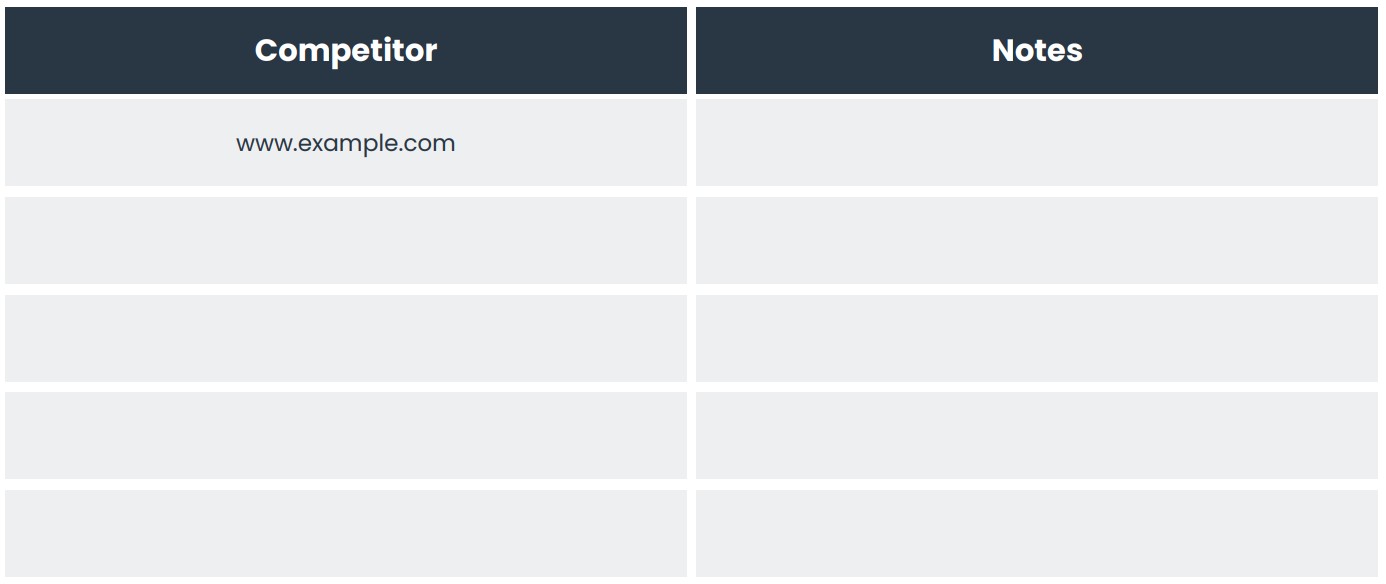
Competitor Questions
Now, for each competitor, ask and answer the following questions.
Design & User Experience
· How intuitive and user-friendly is the website’s navigation?
· Is the website visually appealing and aligned with modern design trends?
· How responsive is the site across devices (mobile, tablet, desktop)?
Content & Messaging
· What type of content is featured (blogs, case studies, videos)?
· How clear and compelling is the brand’s messaging?
· How frequently is the content updated?
SEO & Performance
· What keywords is the competitor targeting?
· How well-optimised is the site for SEO (meta descriptions, alt texts, etc.)?
· What is the site’s loading speed, and are there any performance issues?
Engagement & Conversion
· What call-to-actions (CTAs) are used, and how effective do they seem?
· How easy is it to find contact information or make a purchase?
· Does the site engage users with newsletters, chat features, or other interaction tools?
Notes
Make some general notes for each competitor.
Final Score
Give each competitor a score out of 10 (and feel free to revise these as you go through).
2.2. Your current website
Now, with the benefit of having reviewed the competition, review your own website (if you have one).
Design & User Experience
· How intuitive and user-friendly is the website’s navigation?
· Is the website visually appealing and aligned with modern design trends?
· How responsive is the site across devices (mobile, tablet, desktop)?
Content & Messaging
· What type of content is featured (blogs, case studies, videos)?
· How clear and compelling is the brand’s messaging?
· How frequently is the content updated?
SEO & Performance
· What keywords is the competitor targeting?
· How well-optimised is the site for SEO (meta descriptions, alt texts, etc.)?
· What is the site’s loading speed, and are there any performance issues?
Engagement & Conversion
· What call-to-actions (CTAs) are used, and how effective do they seem?
· How easy is it to find contact information or make a purchase?
· Does the site engage users with newsletters, chat features, or other interaction tools?
Notes
Add some general notes.
Final Score
Give yourself a score out of 10.
2.3. Traffic & Performance
Another key area that is often overlooked when planning a new website is the current traffic, particularly organic traffic, and also, any high performing pages.
Your goal here is not only to address the shortcomings of the current site, but also to carry over, and build on the things that do work!
The key areas to look at here are:
Organic Traffic: Understanding current visibility
Organic traffic can be some of the highest converting traffic, and of course, it comes without those annoying costs-per-click. Your goal is to understand what drives organic traffic and carry it over to the new site plan where possible.
Organic Traffic Review
For this review I would suggest reviewing your Google Analytics filtered by organic traffic and Google Search console to get a true picture of what you rank for and get clicks for.
Top-performing pages: Identify which pages bring the most organic traffic. What keywords relate to each page?
Top keywords: What terms are driving impressions and clicks? What pages are these
for?
Backlinks: Which pages have strong inbound links? Use Google Search console plus tools like Ahrefs or SEMrush to catalog these.
Document this information now and ensure you factor this in when designing your sitemap in Step 4 – Hierarchy.
Conversions: Understanding high performance content
The next job is to understand what pages on the site are feeding your business with leads and sales. Equally, it is helpful to understand what does not work so you can learn from that.
We would suggest, at a minimum, the four below tasks.
Review highest conversion pages: make a list of your highest conversion pages so you can ensure these pages are included in the new sitemap.
Review highest conversion rate pages: review the features of high conversion rate pages. What do they do well? How do users interact with these pages?
Review lowest converting pages: what pages have good traffic but a low number of conversions?
Review lowest conversion rate pages: What pages have traffic but poor conversion rates? Why do these pages not convert? Answering these questions will help you when you come to map out the structure and content of your pages (Step 6 – Mapping).
Note: Analytics
This analysis requires that you have this i1nformation in your analytics software (typically Google Analytics 4.0). If not, we would recommend setting this up so you can gather this intelligence (or you are going in blind!).
Again, document all of this and move on.
Website SEO
To simplify any cross referencing in future we would always suggest crawling your
existing website and saving that information. We would recommend Screaming Frog for this so you have a record of all standard on-page SEO factors (page titles, meta descriptions, H1s, content etc).
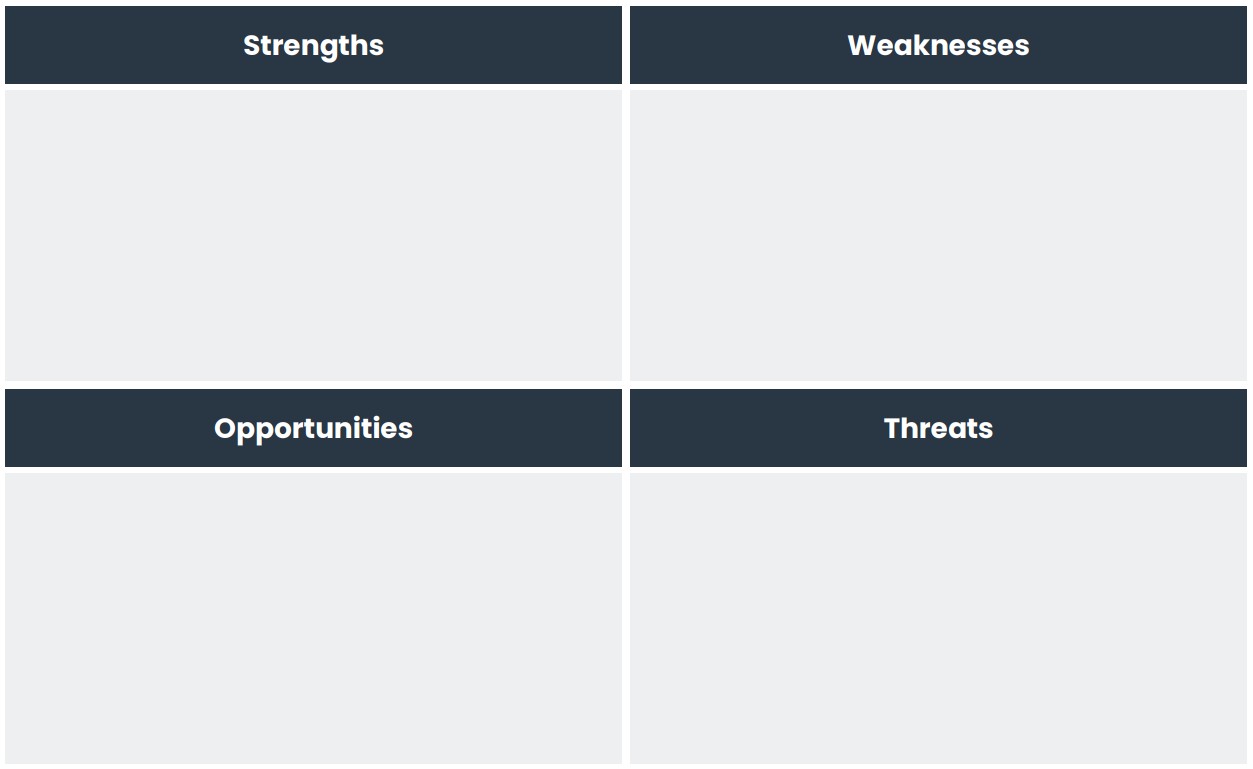
2.4. Website SWOT
You should now have an understanding of your strengths and weaknesses in relation to your customers needs, current website and the competition.
Our goal now is to carry over strengths, address weaknesses, seize opportunities and counter threats – so lets document everything important in a simple SWOT before moving on.
2.5. Website Strategy
The goal here is to get a clear understanding of what works, what does not work and where you are strong and weak in relation to the competition.
Whilst there is nothing magical in this procedural review the rigour here is necessary to aid you in making smarter decisions about the new site and in ensuring anything that does work carries over.
The next step is to try and distill all of these lessons into a clear strategy. The careful articulation of this will help guide the project forward and keep you on track.
Ideally, you should be able to define this in a simple statement along the lines of: “Our strategy for the website is to [core action or direction], in order to [primary goal], because [insight or reason from research].”
Book a Strategy Call
Give us a call, drop us an email or fill out the form and one of our web design experts will get right back to you.
- 0121 314 2001
- [email protected]
- 112 Zellig, Custard Factory, Birmingham, B9 4AT
